
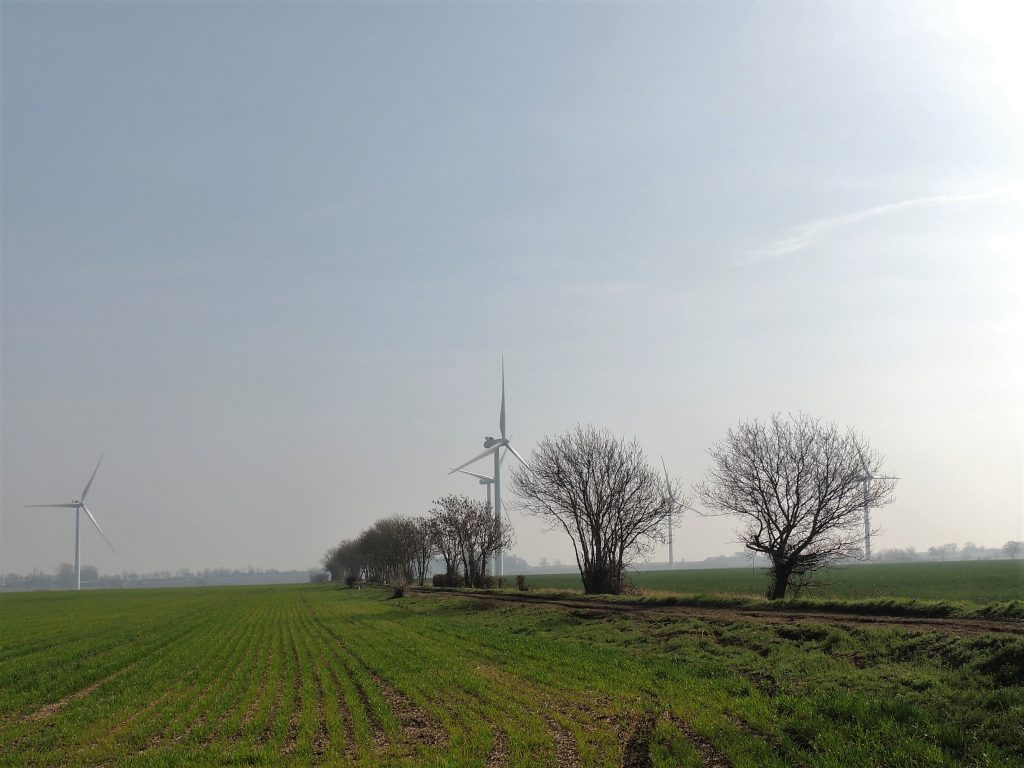
In 2011, we successfully campaigned for planning permission for a 10-turbine wind farm in Biggleswade after the council attempted to block permission due to noise and visual impact.
Central Bedfordshire Council voted to refuse planning permission for the wind farm, which was appealed by the Co-Op, who had submitted the application. The case was taken to the independent Planning Inspectorate.
Raising money to give evidence
We raised £1,500 to employ Ian Bennett, Editor of the Acoustics Bulletin to give evidence to the Planning Inspector and support the Co-Op’s case. CBC had employed Mike Stigwood of MAS Consulting, whose evidence had been responsible for stopping the Poddington wind farm and the Denbrook wind farm, among others.
We also gave evidence on the urgent need to cut greenhouse gases to prevent dangerous climate change of over 2 degrees, which was quoted in the Inspector’s report.
The inspector dismissed the methodology of the CBC’s noise consultant in favour of the noise consultants employed by Co-Op and our group.
The 10-turbine wind farm was built, and is situated between the A1 and the East Coast Mainline railway line beside Langford just south of Biggleswade. The wind farm generates enough energy to power 11,000 homes.
Victoria Harvey, Resources Manager at South Bedfordshire Friends of the Earth said of the results: “If you can’t build a wind farm between the A1 and the East Coast Mainline Railway in an area of no landscape designation, where can you build a wind farm and how will the UK meet its climate targets? There is a real need for a clear understanding of the noice issues, what constitutes harm for visual impact and the urgent need for renewable energy and we are thrilled that this inspector’s decision is so clear and helpful on these issues.”
Summary of issues in the Planning Inspector’s report
Noise
The key dispute is over the measurement of wind shear which is the noise created by the turbine blades due the difference between wind speeds at different heights.
This is measured either at 10m, as originally suggested in 1997 in the original guidance, or at different heights including hub height, as laid out in an article signed out by several top acousticians in the Acoustics Bulletin 2009. This has been the subject of many lengthy public inquiries. Mike Stigwood believes wind speeds should be measured at 10m high as originally suggested in the guidance, ETSU R 97. However, although ETSU R 97 lays down the limits for noise from wind turbines, it does not prescribe the methods. It suggested 10m height as this was the height of most measuring equipment at the time of the guidance in 1997 and wind turbines were a lot shorter than they are today.
As the height of turbines increased, the issue of windshear became more important and affected the eventual noise of wind turbines. A group of top acousticians, some of whom were involved in writing the original guidance on noise, published and signed an article in March 2009 in the Acoustics Bulletin which states that wind speeds should be measured at different heights including hub height in order to work the actual wind shear. This means as the Inspector for the Biggleswade wind farm said that the noise levels can be more accurately measured from measuring different wind speeds at different heights. Then work out a derived limit for 10m than a fixed 10m wind speed, which thereby gives more protection to nearby residents.
The inspector sums up his view of the Acoustics Bulletin article: “I share the view of my colleague in the Spaldington Case, that it is an adequate methodology, that it does not undermine the objectives of ETSU, that it does not disadvantage residents and that it represents current good practice. Overall I consider the Appellant’s approach to wind shear to be generally robust and the Council’s challenge (Mike Stigwood) to it unconvincing.”
SBFoE believes that this debate is wasting public inquiry time and therefore a huge amount of taxpayers’ money and holding up renewable energy; this debate should be taking place within the professional world of acousticians not in public inquiries. At the Inquiry Ian Bennett confirmed that Mike Stigwood has not entered into the debate in the Acoustics Bulletin but has used public inquiries to argue these points.
Visual impact
The Inspector gave considerable attention to the effect of the wind farm on the views of the local residents. He also gave a very good explanation and summary of the issues that should be taken into account when assessing harm to visual amenity.
He explained the fact that wind farms are visible and changes the view is not a planning reason to refuse an application – para 17. “It is a well held planning principle that there is no “right to a view” such that an attractive or cherished outlook from a private property can be protected from development that would adversely affect it. The fact that the proposed wind turbines would be seen from dwellings in and around Langford, and in some cases would be prominent and would significantly change views of the countryside, is not determinative in itself.”
He continued to explain the “public interest case” which is the basis for assessing whether there will be harm to visual amenity.
It was agreed at the Inquiry that the appropriate test by which to judge the overall magnitude of visual impact on local residents is what was described in the Spaldington case as “the public interest test”, and which has been widely applied by Inspectors and by the Secretary of State. This is to ask the question “…would the proposals affect the outlook of residents to such an extent, i.e. be so unpleasant, overwhelming and oppressive, that the property would become an unacceptably unattractive place in which to live?” I endorse and adopt this approach with the rider that the perception of the effects should be as though through the eyes of a property occupier without strong views against or in favour of wind turbines.”
The need for renewable energy
The Inspector makes clear the urgent need for renewable energy: “The Overarching National Policy Statement for Energy (EN-1) of July 2011 states that to avoid the most dangerous impacts of climate change global emissions must start falling as a matter of urgency. To hit the 2020 targets new renewable electricity generating projects must be brought forward as soon as possible. Offshore wind is expected to make the biggest single contribution but onshore wind is described as is the most well-established and currently the most economically viable source of renewable electricity available for future large-scale deployment in the UK. The imperative is clear and its urgency is further emphasised in a range of publications referred to at the Inquiry by Friends of the Earth.”
He continued by explaining that the East of England had only reached half of its 2010 target in 2009: “On all the evidence development of renewable energy is not proceeding at the necessary rate in the Region. Nor is the situation very different in Bedfordshire.” He continued to explain the need for developments such as this. “However, in this particular case, where targets are conspicuously not being met, I consider that the 20MW of electricity that the proposal would generate is a significant benefit that shifts the balance in its favour.”